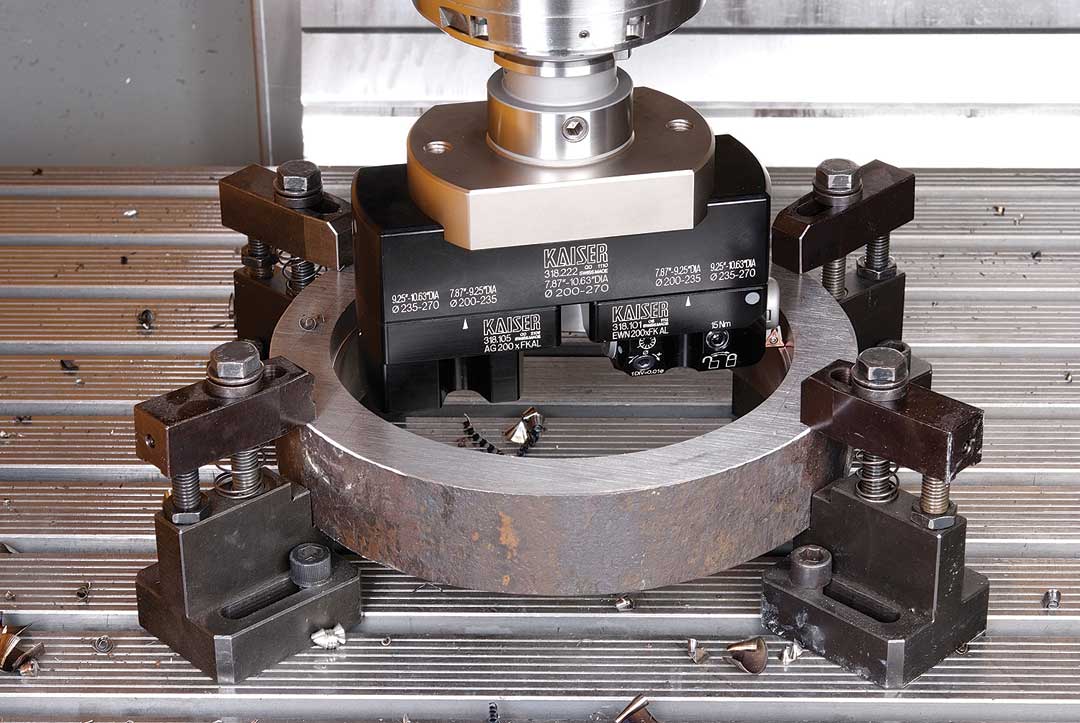
The KAISER 318 modular boring system is lightweight, offering high precision and performance. This large diameter boring system features through-tool coolant supply to the cutting edge.
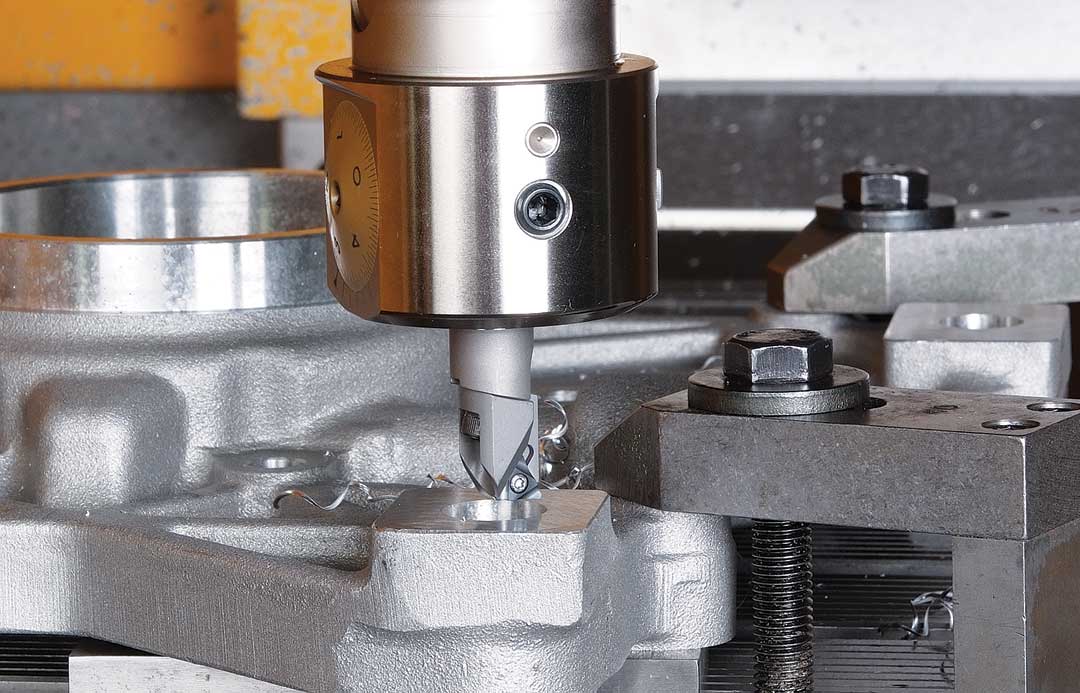
Higher rigidity, and therefore better cutting performance, can be achieved by keeping tool assemblies as short as possible. KAISER fine boring heads with centric boring bars offer variable tool length adjustment, offering the shortest and most rigid tool assembly.
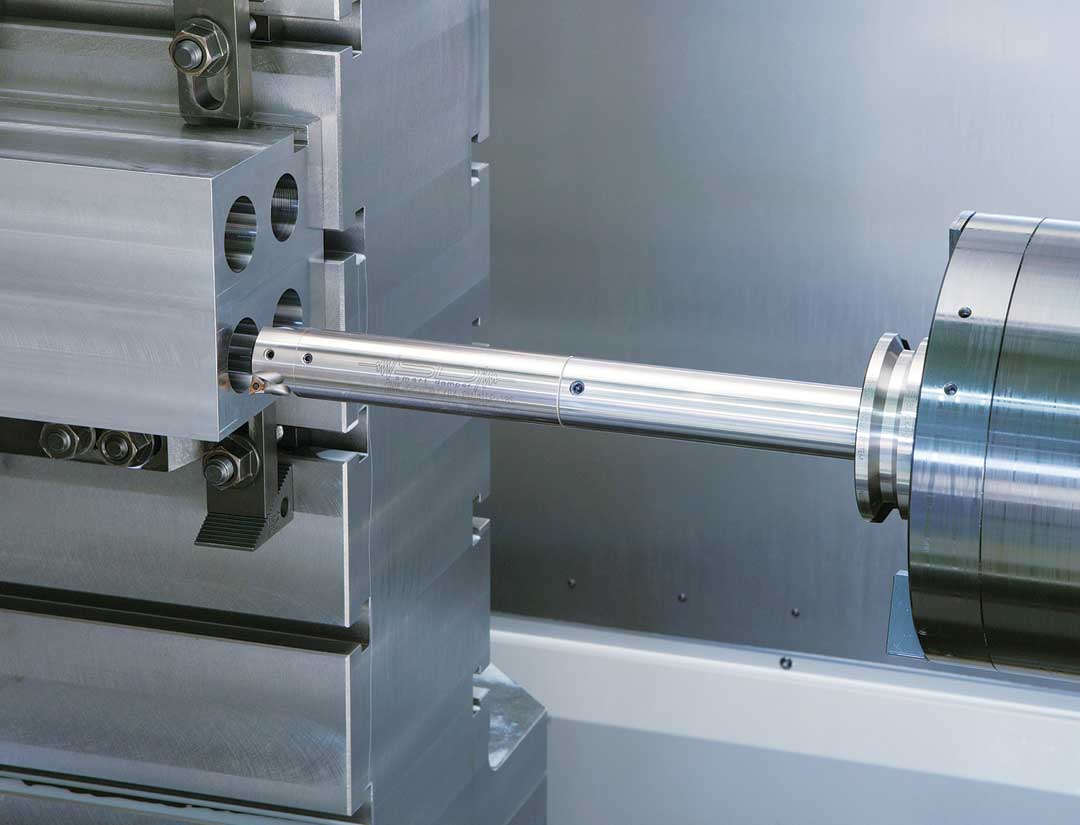
The EWN Smart Damper reduces vibrations and minimizes chatter in deep-hole finishing, leading to improved surface finishes and higher metal removal rates. Furthermore, the EWN Smart Damper supports the use of high-cutting parameters, which results in shorter cycle times and increased productivity.
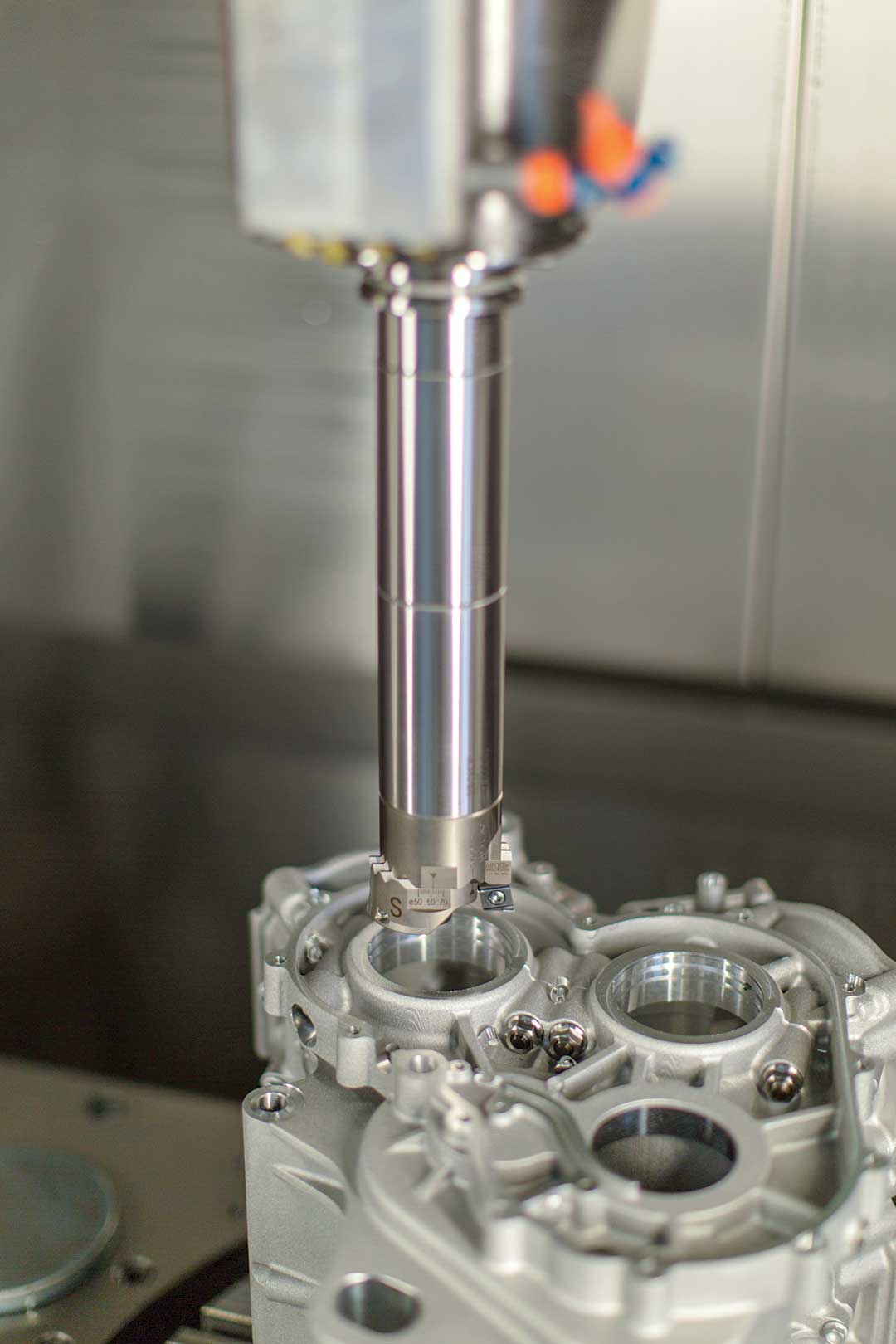
The KAISER SW twin cutters are specifically crafted for heavy-duty rough boring and semi-finishing tasks. A positive, friction-locked connection between the tool body and insert holders helps ensure maximum rigidity and optimal cutting performance. Reverse the insert holders to alternate between balanced and stepped cutting. This innovative design enables various roughing techniques without requiring component changes.
We have all heard the phrase, "Work smarter, not harder." But when it comes to hard-to-machine materials-heat-resistant super alloys (HRSA), titanium, nickel, 300 series stainless steels and more-that is easier said than done. These materials are more prevalent than ever, answering the call for advancements in the industries they support-from aerospace and automotive to defense and medical.
Many of these materials are proprietary creations, and the boring challenges they present can be complex to solve. In short, hard-to-machine materials come with an increased risk of vibration and friction during cutting operations. This causes heat, which does not just wear down cutting tools faster-it can cause the workpiece to harden even more.
Matt Tegelman, Senior Product Specialist at BIG DAISHOWA, noted: "If you do not take the right approach with these materials and the heat from the cutting action transfers into the part, hard-to-machine materials can work-harden. So, you are actually heat treating the part and making it even harder to cut. The goal is to get the heat to transfer into the chip and away from the workpiece."
Tegelman explained that this work-hardening effect is particularly problematic in deep boring applications. The top of the bore might be easy enough, but as the bore goes deeper and the heat builds, machinists will feel the burn.
Beyond the excessive tool costs incurred from burning through bores, operators could see the ill effects in diminished surface finish quality and dimensional accuracy. And subpar accuracy simply will not cut it in the precision applications in which these materials are commonplace.
BIG DAISHOWA outlines five essential tips to help customers keep their cool-and their productivity-when boring hard-to-machine materials.
Get the Inserts (and Coatings) Right
Hard materials call for tough inserts-both in terms of the material and the coating.
Tegelman noted that because hard-to-machine materials require sharp geometries, the quality of the insert is especially important.
"Those materials require a very sharp corner. Unless you have a good coating, the insert edges are going to break down very quickly," he said.
ALCRONA (aluminum chromium nitride) has been a go-to coating for awhile due to its heat resistance and hardness. More recent selections include silicon nitride-based coatings-historically used in high-speed cast iron applications but equally effective for exotic, hard-to-machine materials, too.
When it comes to insert substrates, Cubic Boron Nitride (CBN) is an option to consider. While not as hard as diamond, CBN uses boron as its primary element instead of carbon, making it the next best alternative to diamond.
A word of warning: Polycrystalline Diamond (PCD) inserts are not recommended for use with hard-to-machine materials. As Tegelman explained, "The carbon in PCD would have an affinity to any iron in the workpiece materials. The heat would cause the carbon to leach out and degrade the material very quickly."
Keep in mind, new coatings and proprietary insert materials are coming out all the time. It is crucial to work with a tooling partner who stays on the cutting edge of these developments.
Pay Attention to Geometries
As mentioned, sharp insert geometries are a must, both to bore effectively and to improve chip formation and evacuation (another familiar challenge with hard-to-machine materials). But the sharper the geometry, the more delicate and vulnerable the cutting edge.
Finding the right ratio between sharpness and durability, Tegelman said, is essential. "It is a balancing act. You want it sharp, to be as free-cutting as possible, but in order to maximize tool life, a small radius hone gives you a little more strength right at the cutting edge."
Another tip: be sure you are using a smaller nose radius during finishing operations, which promotes cleaner cutting and reduced cutting forces to manage heat and improve final surface finish.
Optimize Stock Allowance
Wondering why you are burning through inserts during finishing and having issues with finished part quality? It could be issues with stock allowance. While standard applications might be fine with 0.016" to 0.020" of material removal on diameter for a finishing pass, Tegelman recommends cutting that in half for hard-to-machine materials-around .008" to .010" instead.
"One way to minimize your issues with boring these materials is to minimize your depth of cut on your final finished path," he said. "The less material that you are taking out during finishing, the less heat generated, and the smaller the chip, which is all around better for tool life and part quality."
This means you will need to remove more material during roughing operations. Speaking of roughing, Tegelman warns of a common pitfall: "A lot of people rely on interpolation to mill out their bores ahead of time. But especially on these harder-to-machine materials, there is going to be more tool deflection, so you might get tapered or out-of-round holes, especially as your machine tool spindles age."
Stick with traditional rough boring approaches to get off on the right foot with a quality hole to make finishing operations easier.
Get Extra Help for Long-Reach Applications
Hard-to-machine materials often come with other challenges by nature of the applications they serve. Large, complex aerospace or automotive workpieces, for instance, often require long-reach boring. It is a double whammy for operators trying to manage hole quality and tool life. Extended-length tooling assemblies increase the risk of vibration and chatter, which can worsen the work-hardening effect and compromise bore quality.
There is a helping hand in the form of BIG DAISHOWA's Smart Damper technology. The system damps vibrations and reduces chatter in deep-hole finish boring for more effective cutting and smoother hole-making. In fact, these damping qualities can counteract the need for traditionally slow cutting parameters in precision deep-hole boring, allowing operators to improve cycle times-as much as tenfold.
The Right Coolant Matters
High-pressure coolant is vital to flush the longer chips common in hard-to-machine materials and to combat the heat they generate. Here, the quality of the coolant-and the delivery system-matters.
"Anytime you have chips that are not evacuating properly, they can wrap around the tool or get dragged by the tool and therefore hurt the surface finish of the part," Tegelman noted.
This is where the coolant formula and volume matter-high-lubricity coolants reduce friction and improve chip evacuation. Good volume helps stabilize temperature and additionally ensures chips are moved away from the cutting area.
All in all, successful boring of hard-to-machine materials takes patience and a holistic approach. Insert choice, geometries, roughing-to-finishing ratios, and controlling vibration and heat all play a role in ensuring in-spec, cost-efficient holes. And when every dollar counts, the extra effort is worth the result.
Authored by Matt Tegelman, Senior Product Specialist, BIG DAISHOWA
For more information contact:
BIG DAISHOWA Inc.
2600 Huntington Blvd.
Hoffman Estates, IL 60192
888-TOOL-PRO / 224-770-2999
bigdaishowa@us.bigdaishowa.com
www.us.bigdaishowa.com