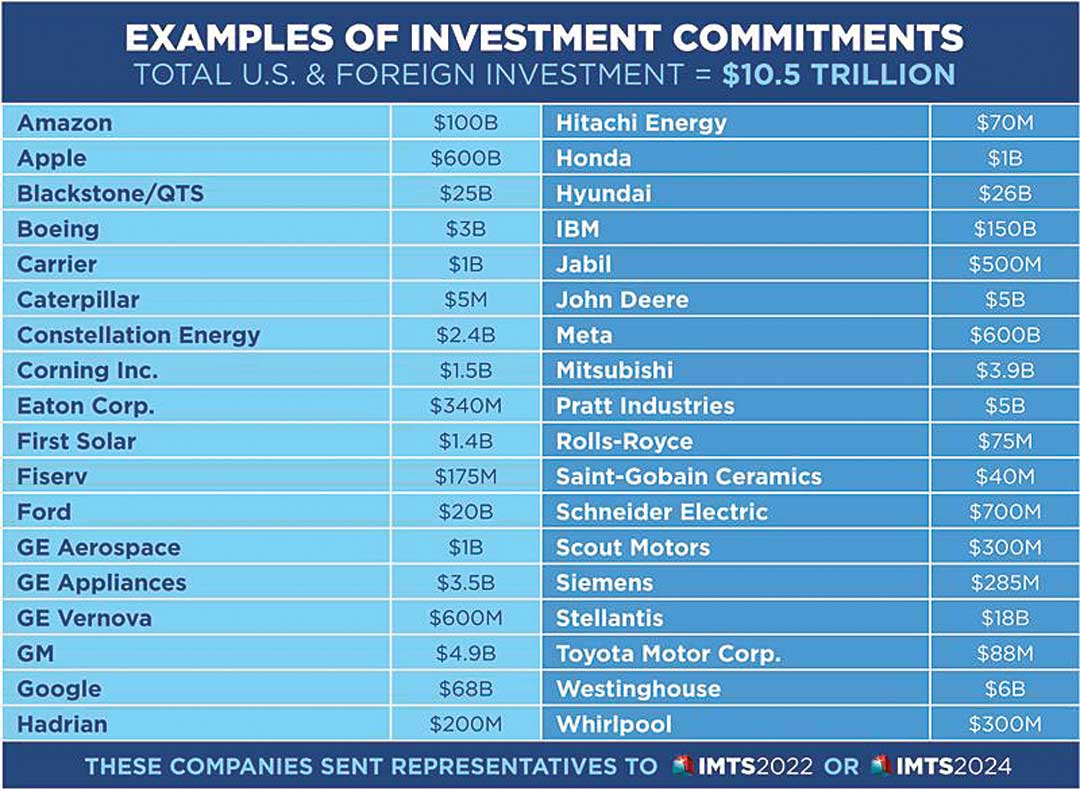
Companies representing a trillion-dollar manufacturing economy visit IMTS to find solutions that enable them to boost competitiveness in dynamic global markets.
The manufacturers at the center of the $2.95 trillion U.S. manufacturing economy will find the core technologies and machines they need to accelerate production at IMTS - The International Manufacturing Technology Show. IMTS 2026, the largest manufacturing technology show in the Western Hemisphere, runs Sept. 14-19 at McCormick Place in Chicago and will feature more than 1.2 million sq. ft. of exhibition space and more than 1,800 exhibitors.
At IMTS 2026, new multitasking, multifunction, hybrid manufacturing, and 5-axis machining centers will be introduced by Okuma America Corp. (booth 338500), Index Corp. (booth 339119), Tsugami America (booth 339410), Mazak (booth 338300), Matsuura Machinery (booth 338630), Haas Automation (booths 338100, 338884, 432212), JTEKT (booth 338700), Marubeni Citizen-Cincom (booth 339419), DN Solutions (booth 338919), and others.
"IMTS also showcases how AI, software, automation, and other digital solutions advance the capabilities of machine tools and other foundational technologies," said Travis Egan, Chief Revenue Officer of AMT. "U.S. companies outcompete other regions through their willingness to innovate and adopt new technology faster."
One shop taking advantage of technology and IMTS is Marathon Precision, a 60,000-sq.-ft. machine shop in Wheeling, IL.
"For the week of the show, IMTS is the largest, most advanced shop in the world," said Marathon Precision owner Michael Bauer. "If you buy technology before anybody else and get good at it, chances are you can win new business." At IMTS 2024, Marathon purchased a Matsuura (booth 338630) MAM72-52V 5-axis CNC and a Haas machining center (booths 338100, 338884, 432212), both with pallet feed systems.
"The quality of the equipment directly impacts the quality of the part," said Jim Belosic, founder and CEO of SendCutSend, an on-demand manufacturing company specializing in custom sheet metal and CNC machining with three U.S. locations. "By investing in the best-of-the-best CNC and fabrication equipment, we are able to produce better parts faster, with fewer defects and less post-processing, which ultimately lowers costs and improves reliability for our customers."
"Manufacturing demand continues to expand across aerospace, defense, medical, energy, and advanced infrastructure, such as data centers," said Michael Huggett, President and CEO of Index Corp. (booth 339119). "This growing demand arrives hand in hand with increased product complexity, tighter lead times, and ongoing skilled labor constraints. For many manufacturers, the focus has shifted from simply securing work to ensuring they have the capability, capacity, flexibility, and efficiency to deliver it."
"When we think of finding solutions at IMTS, we automatically think of a particular machine tool, but what we really need to meet today's challenges is the mindset of multitasking," said Tim Thiessen, Vice President of Sales at Okuma and also a member of the AMT Show Committee. "The most efficient shops are those with machining centers that bring multiple processes or multiple steps together and make them work as one."
At IMTS 2026, Okuma will launch its Multus U1000 and U2000 multitasking machines, and Index will debut its Index G160 multitasking machine. By completing complex parts in a single set-up, manufacturers can eliminate secondary operations while improving accuracy and consistency. These new, advanced mill-turn centers feature the capabilities of larger systems in a more compact footprint, enabling shops to increase capabilities within their existing walls. Both machines offer full 5-axis interpolation for machining complex contours and driven tools for all machining tasks in C, Y, and B axes.
Okuma will also feature its new LT2000 EX, a twin-spindle turning center in the 6" chuck class. With the ability to combine the upper and lower turrets with either spindle, users can complete the greatest amount of primary and secondary machining possible in one compact platform.
Index will also showcase the MS24-8 CNC multi-spindle. With eight spindles and modern set-up efficiency, this machine combines high-output capability with the flexibility manufacturers need to remain competitive in changing markets.
For multitasking applications that require grinding, the new Mazak Integrex i-350S Neo includes a main and second turning spindle and a milling spindle headstock to integrate turning, milling, and, for the first time, grinding in one set-up. The main and second turning spindles operate at 4,000 RPM, while the compact milling spindle comes standard as 12,000 RPM and optional 20,000 RPM for high-speed machining of aluminum and small diameter machining.
To improve the productivity of existing lathes, consider advances in bar feeders. Edge Technologies (booth 338440) Executive Vice President Rick Bauer noted that technologies, such as auto-adjustment to accommodate different bar sizes and short loaders, support low-volume, frequent changeover, and short-batch production.
"To unlock a lathe's full capabilities, revolutionary sliding (RS) technology positions the bar feeder to be much closer to the back of the spindle to minimize the transition zone and address the `jump rope' effect between machines," Bauer said. "Some shops are running 3/4-inch bar stock at 10,000 RPM in nonguide-bushing mode, a 15% RPM improvement."
As an example of equipment investment, consider Multi-Axis Technologies, based in Kent, WA, which purchased a Taiwan Takisawa TM-2000Y2 (Yamazen, booth 338536) multitasking CNC at IMTS 2024.
"The TM2000Y2 machine is equipped with a dual turret, which allows us to reduce overall cycle time and set-up time on the parts," said co-owner Jay Simpson.
To enable more cutting uptime, also consider supporting technologies, such as pallet pools, bar feeders, and automated/robotic part handling. Marathon Precision Lead Production Engineer Michael Foy initially envisioned the pallets holding the same part for longer unattended run times, but he found the biggest advantage for his high-mix, low-volume operation was having different workholding solutions assigned to a pallet.
"If you have a really complicated job that repeats every three months, you can leave that pallet set up so you do not have to spend hours on alignment," said Foy. "Pallets unlock hidden value."
Explore more technologies, exhibitors, and features at IMTS.com.