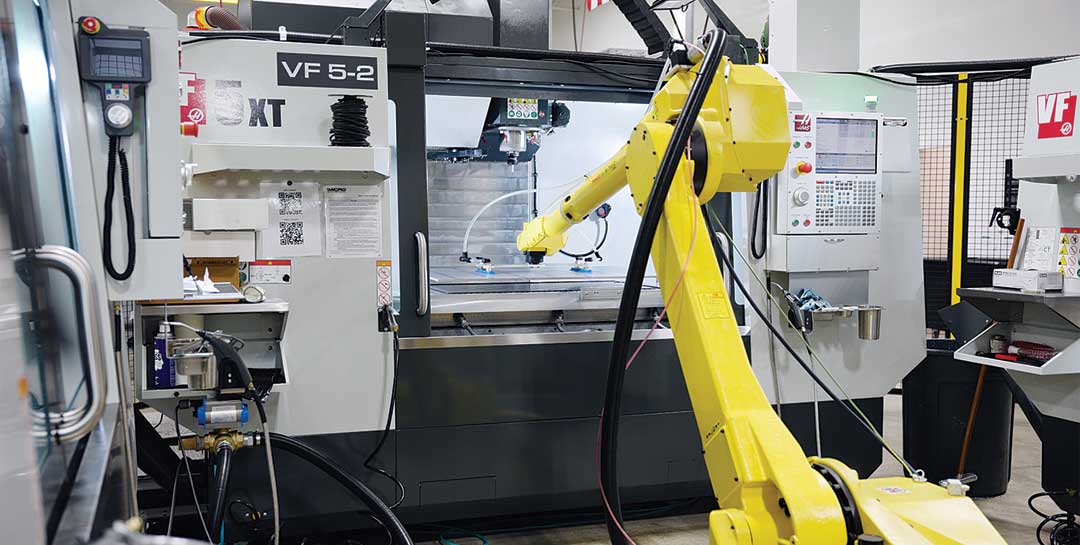
FANUC M-710iC robot arm places a raw aluminum sheet onto the Haas VF-5-2 XT machine table for automated CNC machining.
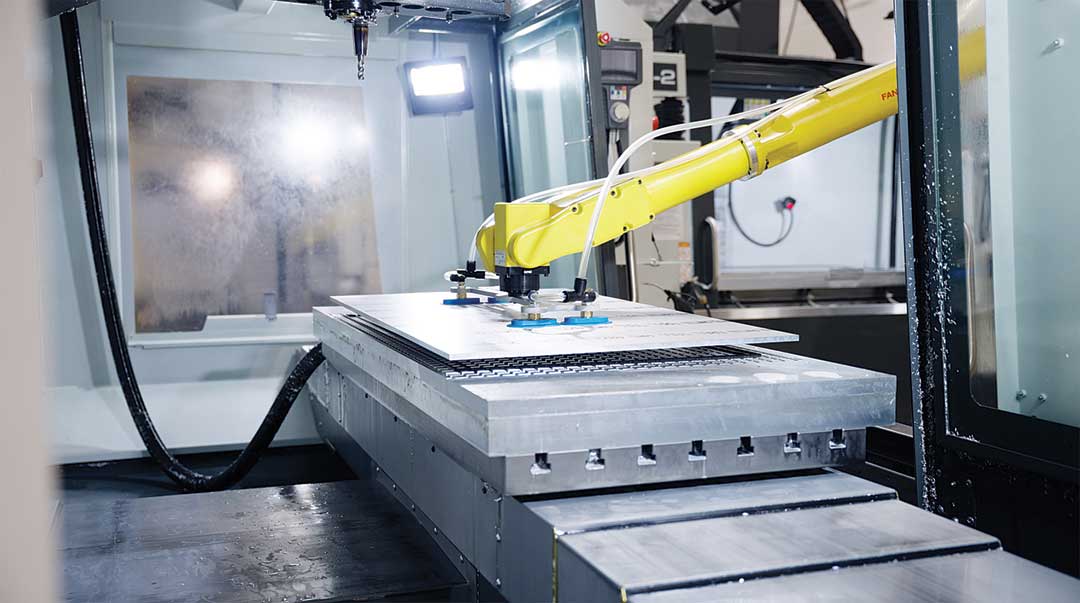
Inside view of the Haas VF-5 CNC enclosure as the FANUC robot precisely positions an aluminum plate onto the machine table using vacuum suction cups, demonstrating seamless robot-to-machine integration.
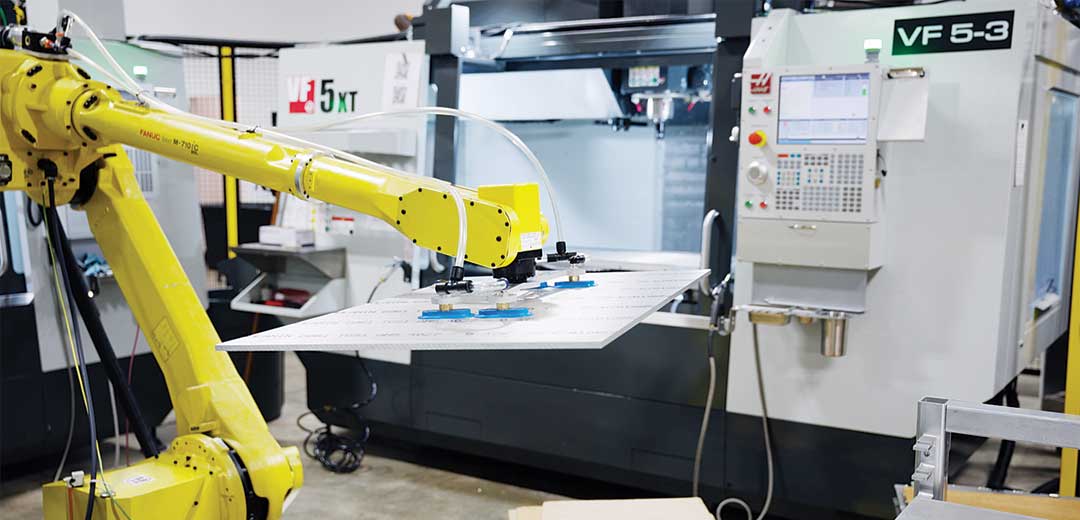
FANUC M-710iC robot arm places an aluminum sheet onto the Haas VF-5 machine table-part of a multimachine automated manufacturing cell.
The United States installed 34,200 industrial robots in 2024-9% lower than 2023. In the meantime, China increased new installations by 7% and now has 2 million+ robots in operation, more than the next four countries combined.
To say that the U.S. is at a disadvantage is an understatement, and ROI is at its heart.
After spending decades on factory floors, in capital planning meetings, and in research labs, my co-author and I always end up here: a manufacturer looks at a robotics investment, runs the numbers, and walks away. Why?
We see manufacturers calculate ROI on robotics investments using a payback period model that often misses 40-60% of what a robotic cell actually returns. We also see available incentives that offset costs get left by the wayside.
Both need to change. We want to walk you through a four-layer framework that helped alliant's client, a leading manufacturer of asset security systems, achieve 60x efficiency gain.
Start with the Right Application
Before any robotics investment, the first question to consider is not "what robot should we buy?" Rather, it is "what process should we automate?" Deploy a robot on the wrong process and it underperforms-that story will get told at every capital meeting, poisoning all future discussions.
The processes that consistently deliver strong returns share a few traits: high repeatability, consistent part geometry, and enough volume to justify changeover time. In precision machining and metal fabrication, machine tending, robotic welding, and deburring hit those criteria perfectly.
For instance, our client ran a Haas VF-5 CNC cell requiring manual loading and unloading of 50+ lb. parts across three machines-work that was slow, injury-prone, and variable. One robot serving multiple spindles was the obvious solution.
But the original process required flipping the part mid-cycle, adding mechanical complexity, cycle time, and failure points. Instead of automating around it, the team eliminated the flip entirely by re-designing the part as a single-operation program. That one decision raised the ROI ceiling before a robot was even selected.
That is what separates a great automation from good ones. If you are only asking, "how do we automate what we are already doing," you are leaving value on the table before you start.
Design for Optimization from Day 1
Most robotic cells run at 70-80% of their actual potential after commissioning. Starting conservative is the right approach. The problem is, it is never revisited.
Speed settings stay where the installer left them. Path planning does not get updated. Lights-out operation never comes into play. The gap between what the cell does and what it could do quietly widens-and nobody notices because it is "working."
alliant's client designed for continuous flow from the start. A FANUC 710 robot loads raw parts into one of three VF-5 machines. Parts are automatically vacuumed into place before cutting-no manual confirmation, no operator intervention. While one machine runs its cycle, the robot moves to the next. No spindle waits on the robot. The robot never waits for a spindle.
The result: 60x the output of the previous manual process, measured within a single 8-hour shift of go-live. Not projected. Not modeled. Measured.
For manufacturers evaluating similar cells, the highest-impact post-commissioning levers are end-of-arm tooling upgrades, in-process gauging, vision systems that handle part variation without reprogramming, and predictive maintenance. None require buying a new robot. They are returns waiting to be unlocked from what is already on the floor.
Integration Depth is Where Multiplier Lives
A robot that loads and unloads parts saves labor. A robot that communicates with the machine tool, quality system, and production scheduler generates return that most ROI models never capture.
In our client's installation, the robot coordinates directly with all three machine tools, synchronizing movements with cutting programs so no spindle waits, and no motion is wasted. The vacuum fixturing confirmation acts as a built-in quality gate. The cut does not start unless the part is seated correctly, eliminating an entire category of scrap at the source. Palletized outfeed means downstream operations receive parts consistently staged, removing handling variability that never shows up in the cell's metrics but always shows up in overall throughput.
That is what deeper integration delivers: a cell that generates data, not just parts. Connected to your MES, it feeds real-time cycle data to your scheduler. Tied to your SPC system, it flags process drift before scrap happens. With full traceability, it tells you exactly which machine, tool, and cycle produced every part in a batch. That data improves decisions across the entire floor-and that value never appears in a payback calculation.
Tax Strategy: The Most Under-Used Line Item in Automation Budgets
The incentives available for manufacturers in the U.S. today are the most favorable they have been in years. Used together, they can reduce the effective net cost of robotic installation by 30 - 40%.
Here is what the stack looks like applied to a cell like the one we have described:
- Bonus depreciation allowed full expensing of the equipment in year one, collapsing what is usually a 5-7-year depreciation schedule. The tax benefit hits in the same year as the investment.
- Section 174A, restored under the OBBBA, made the custom gripper tooling, the vacuum fixturing, and system integration software coordinating the robot with three machine tools immediately deductible in the same year.
- Federal R&D Tax Credit under Section 41 returns 6-8 cents on every dollar spent developing automated processes in-house, like redesigning a part for single-operation machining, developing cell sequencing logic, engineering a fixturing approach, and more.
- State R&D credits (available in 37 states) stack directly on top of the federal credit and can, together, potentially result in six figure refund.
We have had this conversation with numerous manufacturers, and the credit still is not claimed by most. The conversation starts, gets handed to someone in accounting or a CPA unfamiliar with the process, and quietly dies. The work is qualified. The money was there. It just never got captured.
The barrier is not eligibility. It is execution. Capturing these credits correctly requires someone who understands what happened on the floor and how to translate it into a defensible tax position. And it needs to happen before commissioning, not after.
The Bottom Line
The manufacturers who win the next decade of automation will not just be the ones who bought the best robots; they will be the ones who built the complete ROI case and captured every dollar available. That means choosing the right process before selecting the hardware, designing for peak performance from day one, integrating deeply enough to generate data not just parts, and treating tax strategy as a line item-not an afterthought.
Each layer of this framework compounds the one before it. Applied together, they do not just improve the payback period calculation-they make it irrelevant.
Authored by Myron Moser and Dr. Robert Ambrose, Strategic Advisory Board Members, alliant
For more information contact:
alliant
3009 Post Oak Blvd., Ste. 2000
Houston, TX 77056
844-440-2976
contact@alliantglobal.com
www.alliantglobal.com