



Geometry for Roughing Stainless Steel Workpieces
November 1, 2026
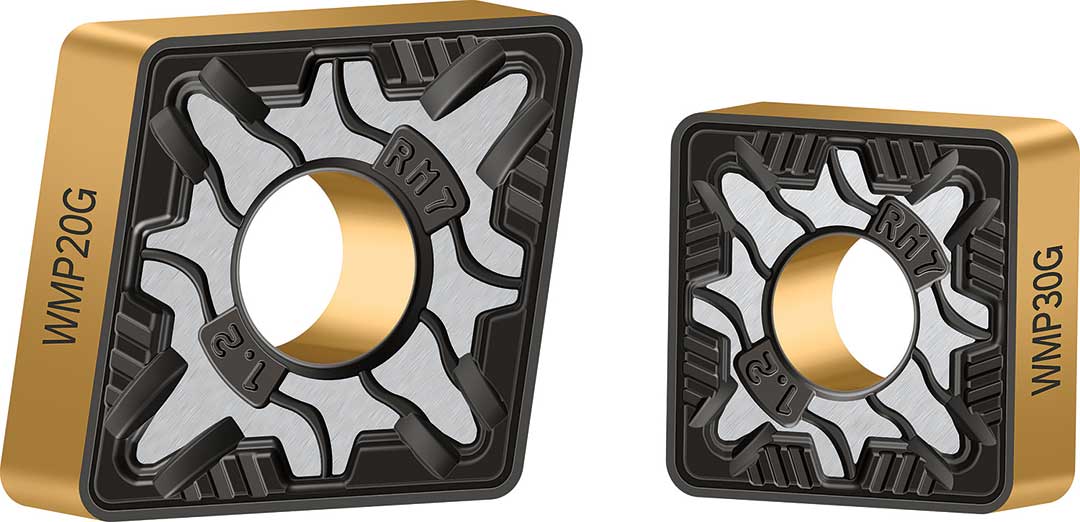
Walter RM7 geometry for roughing stainless steel.
Walter's RM7 roughing geometry is designed to maximize stability when turning challenging stainless steel workpieces. The cutting edge design prevents fractures caused by chip impact. The geometry is available in five basic forms: CNMG, DNMG, SNMG, TNMG and WNMG.
The RM7 negative basic shape geometry is an alternative to the RM5 geometry if it is prone to fractures. In addition, the RM7 geometry can be run at a higher axial depth of cut (ap) and feedrate (f) than the RM5, as well as the MM5 and FM5 geometries. The recommended feed range for RM7 is 0.010 to 0.033 in/rev. (0.25 to 0.85 mm/rev) and the depth of cut range is 0.039" to 0.315" (1.0 to 8.0 mm).
Applications include roughing against the shoulder, interrupted cuts, and turning components that are out of round or difficult to machine, such as one with a weld seam. The RM7 geometry is suitable when the strength of the MM5 or RM5 is not sufficient.
Strength is maximized with a cutting edge that features 0.10 in x 6° protective chamfer and a 20° positive rake angle. According to the company, this is the ideal combination for stability and soft cutting in stainless steel. An enlarged contact surface enhances stability, and a coolant jet guide improves cooling.
The strong cutting edge of the RM7 geometry for rough turning leads to reliable high volume production and reduced downtime, the company reported.
In addition, the newly released Tiger·tec® Gold CVD grades WMP20G and WMP30G work in conjunction with the RM7 geometry leading to extended tool life and toughness against chip impact in challenging rough turning applications in various types of stainless steel alloys.
For more information contact:
Walter USA LLC
1510 S Batesville Rd.
Greer, SC 29650
800-945-5554
www.walter-tools.com/us
< back